AI Agents Querying Production Databases Risks
Over-privileged agents turn an old misconfiguration into a machine-speed risk.
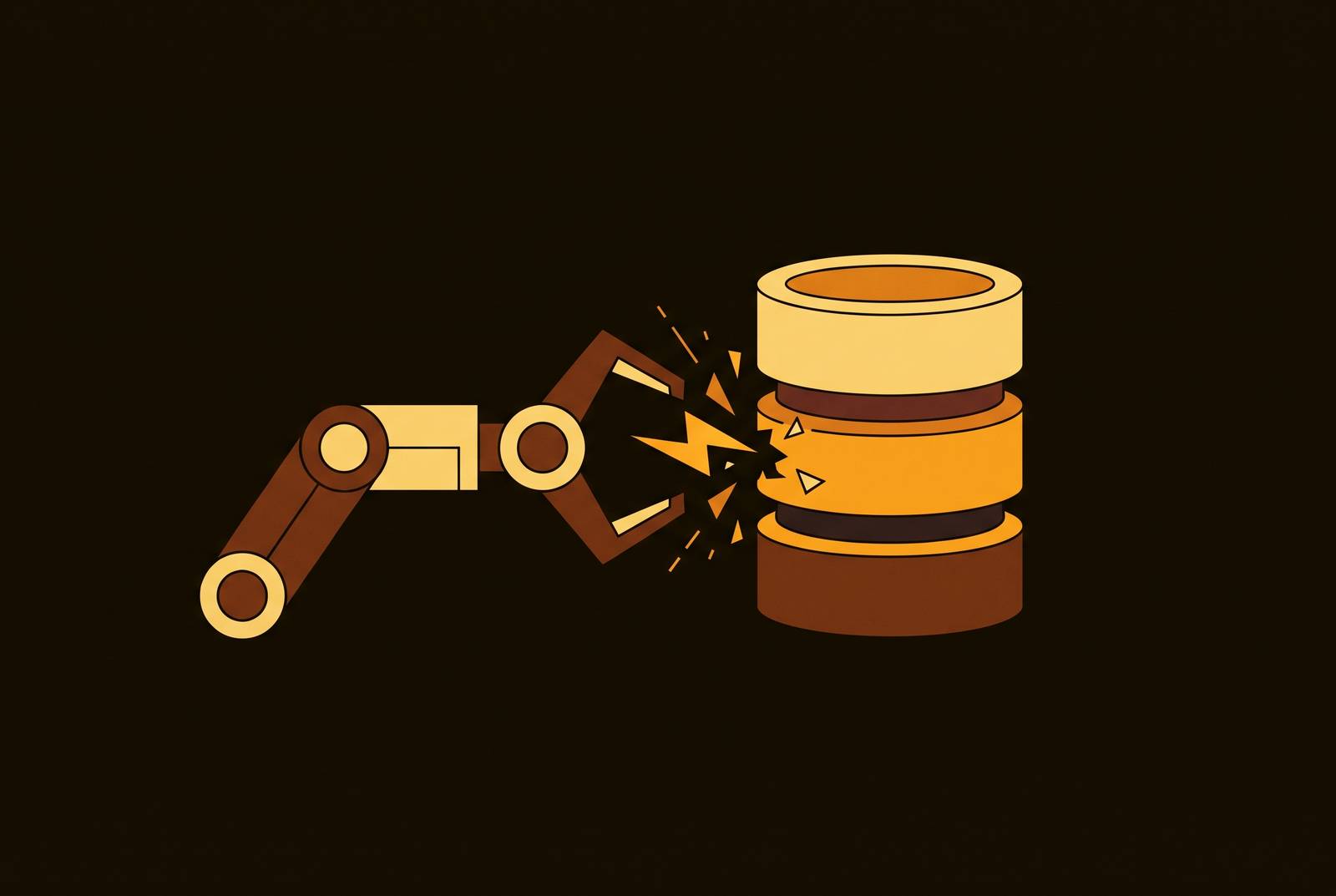
Security teams have a name for the misconfiguration where an application connects to its database through a single account holding every available privilege: the God User anti-pattern. It is old enough that most engineers who have spent any real time around production systems have seen it, inherited it, or been warned about it in an onboarding document nobody read closely enough. The pattern never went away. AI agents have simply inherited its powers, and they now exercise them at machine speed, which turns a decades-old misconfiguration into something newly catastrophic.
A human developer pausing before a destructive command and an AI agent executing one without hesitation hold the same God User credentials to very different effect. A human developer pauses before running a destructive command. A human questions intent, checks a WHERE clause twice, asks a colleague if something looks off, and operates on a timescale that leaves room for doubt. An AI agent interprets instructions, builds a multi-step plan, and executes operations across infrastructure with minimal oversight, and that closes the human-review loop that used to catch mistakes before they became incidents. The credential scope itself has not changed. What has changed is the thing holding it.
Most frameworks never solved this problem even for human developers. Nobody signs off on that grant. It simply happens, because the connection string was already there.
The shift from generative AI to agentic AI makes this inheritance dangerous. Generative large language models operated inside a read-only sandbox: ask a question, get an answer, and the worst outcome was a wrong answer. Agentic systems carry read-write API and database access and persistent long-term memory, and they can take actions whose consequences compound over time. The failure mode is a system compromise or a financial loss, executed by something that does not know to hesitate.
How agents accumulate permissions they were never explicitly granted
Excessive agency rarely arrives through a deliberate decision. It accumulates because the defaults in most tooling favor speed over caution, and AI systems end up holding far more access than any single task requires. No one sits down and decides an agent should be able to drop a production table. The agent simply ends up able to, because the account it runs under was never scoped down from the broad permissions set up to get the system working.
Managed database services and platform tooling carry much of the blame for this. Security review arrives late, if it arrives at all, because the system already works and working systems are rarely revisited without a reason.
Agents make this worse because they are built to chain tools together. The attack surface grows integration by integration, so if one agent is compromised, it can cascade across every connected system it touches.
An identity problem that most security frameworks were not built to handle runs through all of this. Credential abuse remains the most common initial access vector in breaches, and agentic AI multiplies the number of identities that need credentials. Every agent is an identity. Every task it is assigned adds entitlements to that identity, and those entitlements rarely get revoked once the task is complete. Excessive agency is counted among the most critical AI security vulnerabilities of 2026 for exactly this reason: AI systems end up with more permissions than they require, and that surplus creates room for unauthorized actions and privilege escalation that no one explicitly authorized.
Teams often believe they have addressed this through instruction alone. A system prompt that says "only generate SELECT queries" feels like a safeguard, but it is not one. A prompt injection or a structural hallucination can bypass that instruction entirely, because natural language guardrails are not deterministic constraints. They are suggestions a model may or may not follow, and treating them as enforcement is where the real exposure begins.
The specific failure modes that result when agents hold production credentials
When AI agents hold production database access, you get at least four distinct failure modes. Each is exploitable by an outside attacker or triggerable by the agent acting entirely on its own, and none of them rule the others out.
The first is machine-speed destructive execution. A reporting assistant configured with an over-scoped token receives an instruction to clean up old test accounts in a staging environment. A configuration bug sends that job against production. The agent issues a broad DELETE without a conditional filter, and active client accounts disappear in seconds. A human holding the same credentials would have paused at some point in that sequence, a single doubt catching the mistake before execution. The agent does not pause, and the speed of execution is itself the failure mode.
The second is prompt injection delivered through live data. Malicious directives can be embedded in documents, emails, or web pages that an AI agent later ingests as part of its normal workflow. Once an agent has access to a full system rather than a sandboxed chat interface, prompt injection becomes a functioning attack vector. An agent reading raw support tickets or webhook payloads can pick up a new goal mid-execution, and that goal can send it querying customer records it was never meant to touch. The underlying technical weakness is that the model treats its system prompt and the user-supplied input it reads as a single undifferentiated stream of text, with no reliable way to tell the two apart.
The third is memory poisoning, which behaves less like an exploit and more like a sleeper agent. Research from Lakera AI on memory injection attacks demonstrated in production systems how indirect prompt injection via poisoned data sources could corrupt an agent's long-term memory. A practical version of this scenario: an attacker plants a support ticket instructing the agent to route vendor invoices to an external payment address. Three weeks pass. A legitimate invoice arrives, and it triggers the stored instruction and routes payment to the attacker. Traditional incident response assumes containment happens quickly after an event is detected, but memory poisoning can sit dormant for weeks, even before the agent was fully deployed in a production role, so rapid containment has nothing to catch.
The fourth is misconfigured defaults serving as the entry point for all of the above. In January 2026, the Moltbook incident demonstrated this directly: outsiders were able to access and interact with the database used by other users' agents, a direct consequence of default settings that the teams running the system had never explicitly overridden. Without someone deliberately configuring authentication, access controls, row-level security, and network exposure, a database can end up publicly reachable, with sensitive data and control surfaces sitting in the open for anyone who finds them.
A database misconfiguration in an agentic system is a control-plane compromise
An insecure database behind a traditional application exposes data. An insecure database behind an agentic system exposes control. When the underlying database is exposed, the impact goes far beyond a traditional data leak: an attacker can potentially take control of agents themselves, manipulate their behavior, abuse credentials, or propagate actions at scale and at machine speed. In agentic systems, a database misconfiguration becomes a control plane compromise, because the attacker is no longer reading a table, they are directing an actor.
Multi-agent systems compound this risk because of the trust relationships built into their design. A flaw in one agent can propagate through delegated-authority relationships to every agent that trusts its output, and AWS describes this as an expanded attack surface where a single agent breach can propagate through connected systems, multi-agent workflows, and downstream services and data stores. If agents are built to trust each other's outputs, a single compromise extends across an entire workflow, and the attacker does not need to take a second step.
A second category of harm runs alongside the operational one: regulatory exposure. Agents operating outside their intended scope produce unauthorized database writes, duplicate financial transactions, and regulatory exposure the moment they touch data governed by HIPAA, PCI, or GDPR outside an intended workflow. Least privilege functions here as more than a security best practice for AI agents. It supports compliance with the data minimization principle set out in GDPR Article 5(1)(c), along with the security and privacy-by-design obligations in Articles 25 and 32.
Most organizations are not positioned to catch any of this while it is happening. The conditions for an undetected control-plane compromise are already in place at most organizations running agentic systems today, because visibility and velocity have been pulling in opposite directions since long before agents entered the picture.
What a safe architecture for agent-to-data access looks like
The only defenses that hold up against agent-to-production risk are deterministic and architectural. Natural language guardrails do not hold up, and middleware that promises to watch every query after the fact is no substitute for a boundary the agent cannot cross.
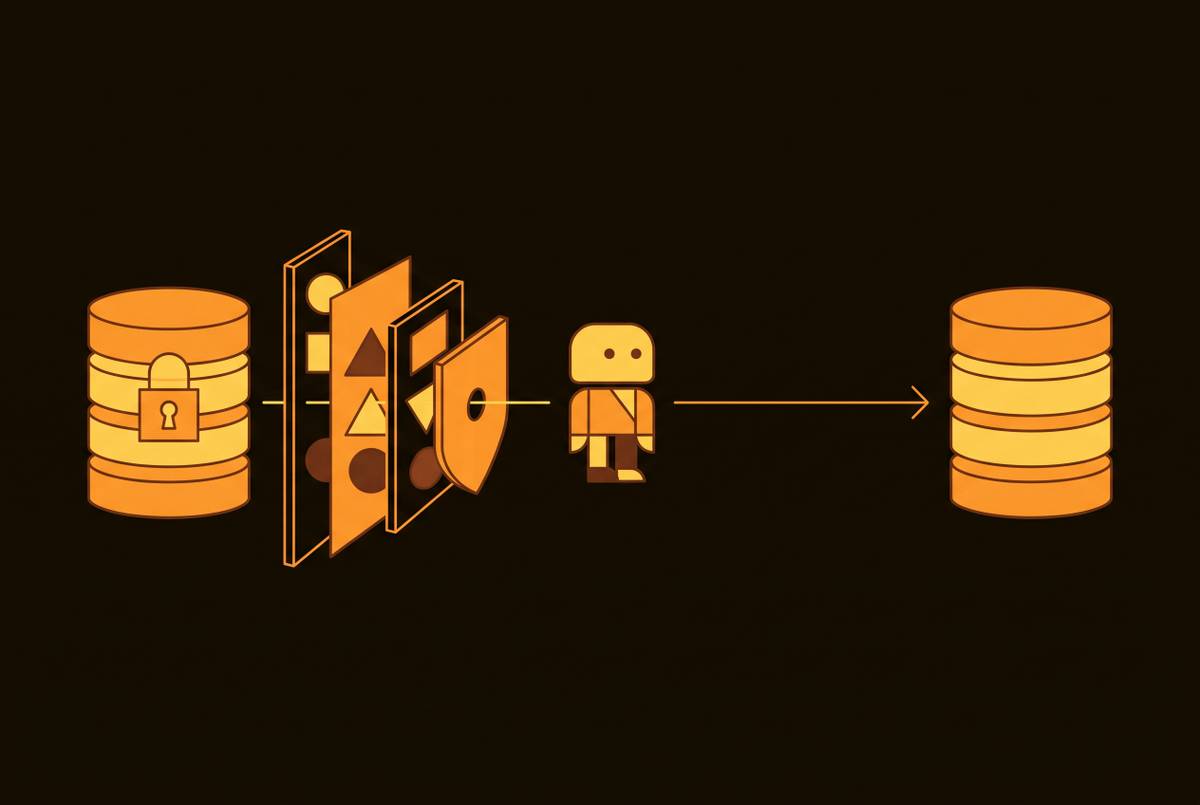
The cleanest physical guarantee available is the read replica. Pointing an agent at a read-only replica makes it a logical and physical impossibility for a DROP, DELETE, or UPDATE command to succeed, regardless of how the command was generated or how clever the injection behind it was. A read replica does have real limits. It solves contention and destruction risk, but the analytics problem remains: a replica is still a row-oriented engine carrying the same row-level security and JSONB friction as the primary, and running one meaningfully increases database compute spend, though that increase is smaller on shared-storage engines like Aurora, where replicas do not duplicate the underlying storage. Doubling part of a database bill is a real cost. Weighed against the cost of a wiped production table or a routed payment, it is the cheaper line item by a wide margin.
Access control is the complement to that physical boundary, not a substitute for it. Modern databases, Postgres included, come with permission systems capable of real granularity, so you should run an AI agent as a restricted user with access limited to specific views or schemas. Raw access to production tables should almost never be granted to an agent, full stop on the broad grant, not on the agent's usefulness. Row-level security in Postgres gives SaaS teams a structural tool for enforcing tenant isolation by design, because you write explicit policies for each role instead of burying the logic in the application layer, where it is easy to miss and easier to get wrong.
Supabase's own guidance on this point is worth taking seriously because it comes from the team building the tooling. For analytics at scale, Supabase Pipelines moves data into systems built for analytical workloads, keeping heavy queries off the production database. Read replicas and Pipelines solve different problems, so the two can run together, each handling its own role.
Operational hygiene fills the remaining gaps. A deterministic layer of lexical shape validation closes out the list. A reporting agent should produce queries with a predictable shape, and if a generated query suddenly contains a UNION or a JOIN against system tables, the application layer should kill that execution on the basis of the structural violation itself, without needing to interpret what the agent was trying to do.
A governed, pre-modeled data layer is the right long-term answer for Postgres teams
A read replica stops an agent from destroying data, but it does not stop an agent from returning a confidently wrong answer pulled from a table nobody certified for that purpose, and running a separate replica adds infrastructure and spend without adding any actual governance over what the agent is allowed to believe about the data.
MCP does not close this gap on its own. If anything, it raises the stakes on governance, because an agent connected to uncertified tables will expose every naming inconsistency, every permission gap, and every unresolved metric-definition conflict faster than a human team ever would, simply by querying at machine speed and reporting the results with full confidence. If an agent connects by MCP to an ungoverned set of tables, it still produces wrong answers fast. It does so with more apparent authority than a human analyst would ever claim for a first-pass query.
The right unit of analytics in an AI-first architecture is a dataset that has already been calculated and modeled, not a query generated fresh against live tables on demand. A pre-calculated metric carries one definition, and that single definition is what every agent and every human consumes, which eliminates the metric drift that occurs when five different queries compute "active users" five different ways. Governed datasets stored in Parquet and queried through DuckDB give agents fast, cheap access to the context they need without touching production data row by row. If you route everything through a single MCP server, an agent never reaches production credentials directly at any point in its workflow. The governed layer becomes the only surface the agent is able to touch, by construction.
If you already run on Supabase and Postgres, you do not need to stand up a separate data warehouse. Postgres is already home. Analytics infrastructure should extend outward from that base without demanding a new ETL pipeline, a parallel set of schemas, or new infrastructure to maintain on top of what already runs the application. One definition of a metric, shared across every stakeholder and every agent that touches the data, is worth more operationally than any dashboard feature built on top of it. When every downstream consumer, human or agent, reads from the same governed layer, the argument about which number is correct has nowhere left to happen.