Data Sprawl in AI-Augmented Engineering Teams
Autonomous agents need governed data layers to prevent errors from spreading at machine speed.

Data sprawl in AI-augmented engineering teams makes fragmented business information a source of structural failure. Autonomous agents can act on inconsistent, stale, or improperly exposed data at machine speed, carrying mistakes into downstream work. A single governed data layer is therefore a prerequisite for safe AI-augmented engineering.
Why data sprawl was already a structural problem before AI agents arrived
Early-stage data sprawl is primarily a fragmentation problem. Product databases, billing systems, CRMs, and spreadsheets each hold useful information, but no shared semantic layer explains how it fits together. One engineer calculates revenue with SUM(revenue), while another uses SUM(amount_captured). Both calculations can appear reasonable within their own systems, yet the numbers diverge. No one may spot the difference until an investor asks for audited figures.
Over months, they learn which reports are current, which fields nobody trusts, and which source is authoritative. When a definition is unclear, they can ask a colleague or flag the uncertainty. Traditional governance assumes this human pattern of consumption, with access requests, reviews, grants, and periodic audits. This setup still has gaps, but people can use their judgment to limit some of the harm.
An autonomous agent does not arrive with that accumulated context. Unless the infrastructure supplies table definitions, ownership, freshness, and access rules, it can select a plausible table and deliver an incorrect answer with confidence. Starburst's October 2026 analysis identifies secure access to live data, reliable interpretation across schemas, and queries without intermediate human approvals as requirements for production-grade outcomes. The change is therefore not simply that agents query faster. They replace the informal judgment that previously helped keep fragmented data usable, while allowing errors to propagate downstream.
Why data freshness is a safety requirement for agents, not a performance preference
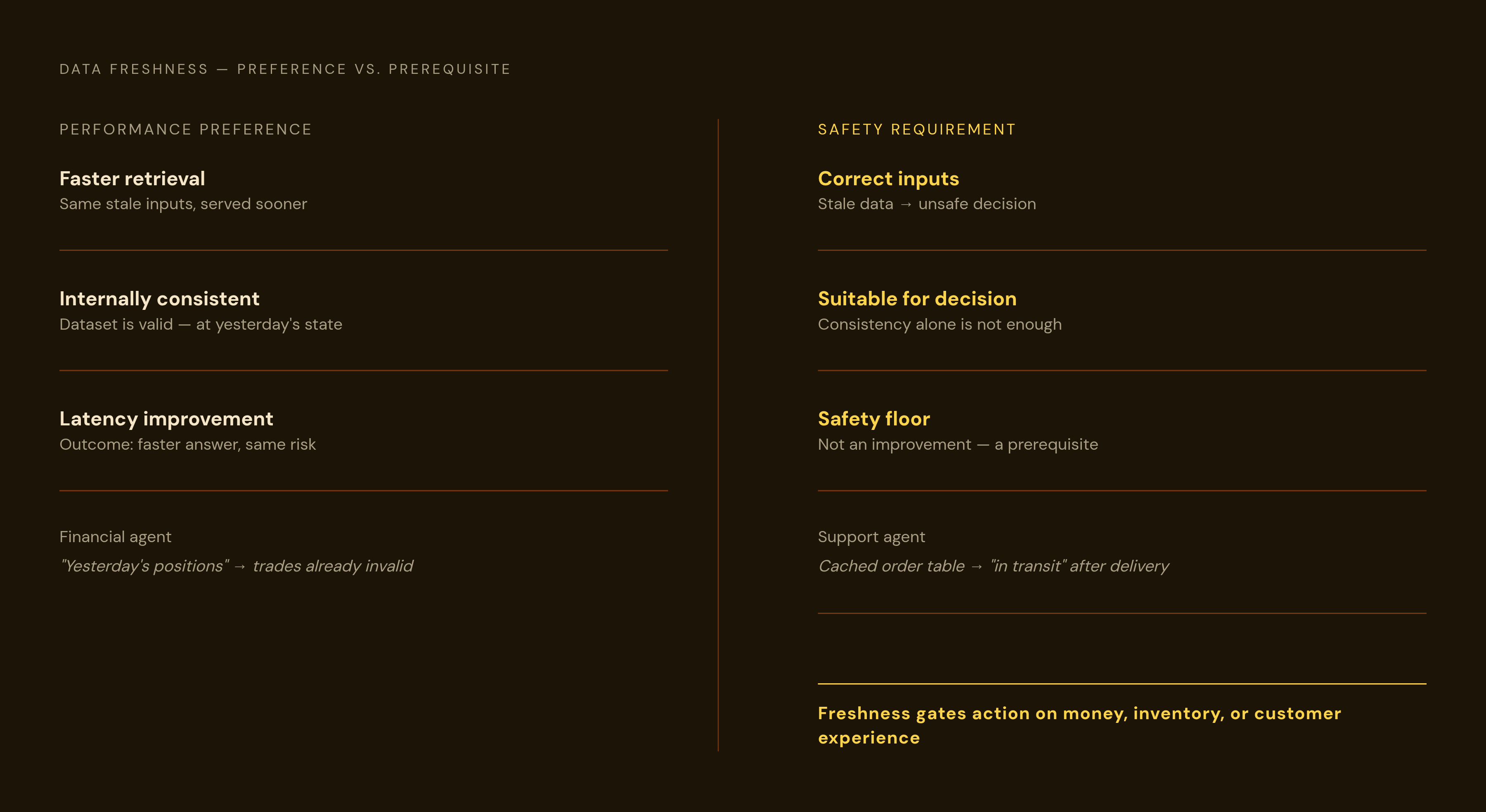
Once an agent acts on data, freshness becomes part of the action's safety. An hour-long batch schedule can leave it reasoning about conditions that no longer exist. A financial agent working from yesterday's positions may generate trades that are already invalid. A support agent reading a cached order table may report that a package is in transit after it has been delivered. In both cases, the problem is not slow retrieval but an answer grounded in an obsolete state.
This distinction changes how freshness should be understood. A dataset can be internally consistent and still be unsuitable for a decision affecting money, inventory, or customer experience. Faster processing only lets an agent get to its answer sooner using the same stale inputs. Freshness is therefore a safety floor for the workflow, rather than an optional improvement to its performance.
Agent access patterns also make the problem broader than refreshing an analytical table. A human analyst may run one analytical query, whereas an agent can combine vector searches, SQL queries, and key-value lookups within a single workflow. Standard data infrastructure was not designed to serve these retrieval patterns concurrently. The access layer must consequently provide useful context about freshness as well as access to data. Without that context, permission to read a source says nothing about whether it is fit for the decision.
Why governance must live inside the data access layer, not in the agent or the application
Application policies and session-level controls cannot do all the work of governance for agents that run continuously. Promethium's 2026 governance playbook identifies continuous operation, machine speed, missing semantic context, and multi-agent interactions as reasons traditional controls fall short. An agent given broad access in January may still use it in August. Monthly reviews cannot match the speed at which it acts, and technical permission does not tell it which data it was intended to use. A session grant is therefore too coarse a boundary for governing each action.
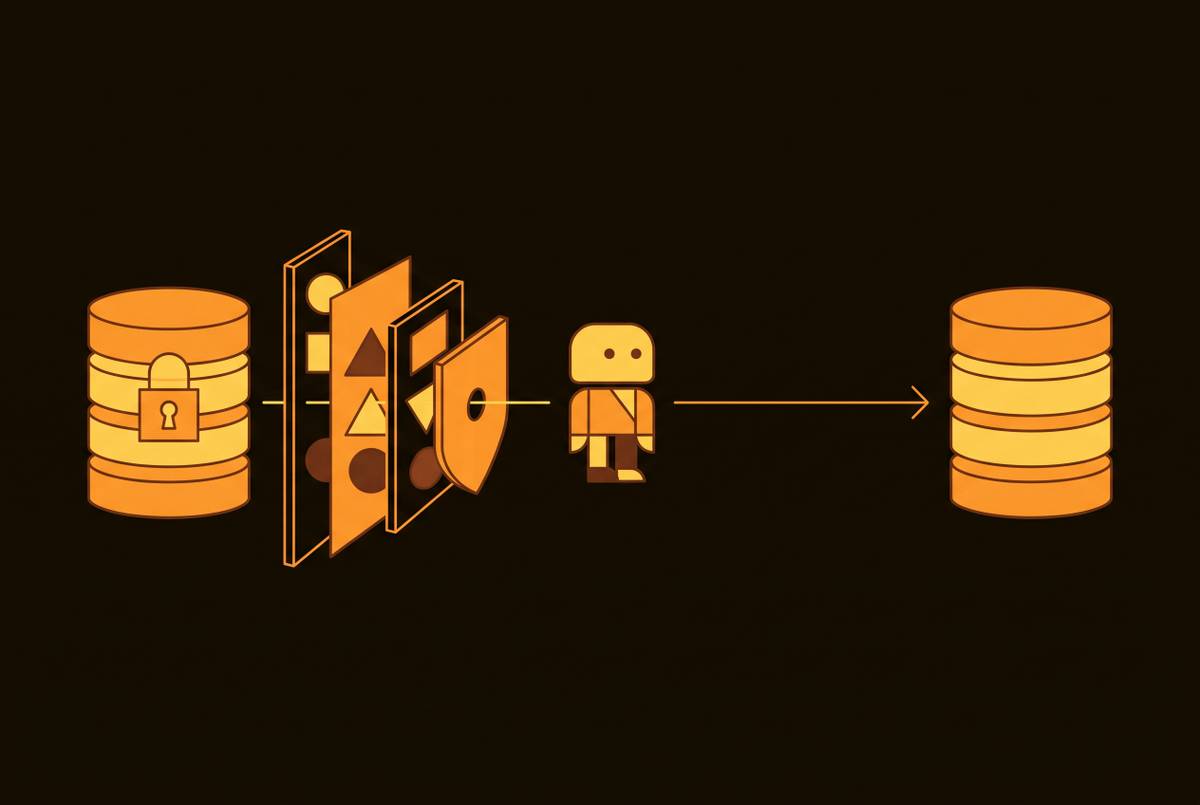
Governance must be enforced at the data access layer on every request. Starburst calls this an “agentic control plane” that grounds agents in shared business meaning before they reason. Row-level security limits the records an agent receives, while column-level masking redacts sensitive fields within otherwise permitted results. A fraud detection agent can get transaction amounts and timestamps without getting payment card numbers. Read-only enforcement and audit trails belong in this controlled interface from the start.
Each agent also needs a distinct identity, with unique credentials, explicit permissions, and a documented lifecycle. A support agent and a financial reporting agent should each have their own API keys and database credentials. A compliance reporting agent can ingest unmasked PII from a data quality agent's intermediate output, violating GDPR even when both remain within their stated permissions. Governance must control how data is accessed and exposed as agents interact, instead of relying on each application to police only what it does on its own.
What proof-derived authorization adds when identity-centric controls are not enough
Valid credentials establish identity, but they do not establish that an action is safe. Jun He and Deying Yu's May 2026 preprint on verifiable agentic infrastructure describes agents generating syntactically valid but semantically unsafe actions. Broad standing permissions expose this gap because agents generate actions non-deterministically. Adding role-based access controls does not, by itself, establish whether a particular action is admissible in its present context.
The preprint proposes intent governance, in which agents submit proposals for state changes. Infrastructure evaluates each proposal against context and policy before allowing execution. Authorization then concerns the specific action. However, intercepting a request, checking policy, and issuing a token can still leave a single point of failure and an unauditable decision gap. A Justification Proof encodes the basis for admitting the action so the decision can be verifiable, distributed, and replayable. This proposed deeper authorization model requires more than giving an agent a scoped credential.
MCP as the connective layer between agents and governed data, and where it still requires work
MCP provides the connective layer through which agents reach databases, APIs, and internal tools. Its servers give agents structured access to enterprise data without the need for a separate access pattern for each source. That common interface is a genuine advance for governed agent workflows. However, rapid adoption has outpaced the development of the protocol's security model. A standard connection does not make the data or the actions behind it safe.
The July 2026 specification revision made MCP stateless at the protocol layer. It removed the Mcp-Session-Id header and protocol-level session, allowing any request to reach any server instance. A remote server that once needed sticky sessions and a shared session store can now run behind a plain round-robin load balancer. This simplifies deployment through ordinary HTTP infrastructure. It does not remove the need to enforce policy on each request.
For hardened headless deployments, every endpoint should sit behind OAuth 2.1 middleware. The authorization specification mandates OAuth 2.1 and recommends Client ID Metadata Documents for client registration. Each agent context should be sandboxed, tokens should be tightly scoped, and tools should never inherit more permissions than they need for the task. Confused-deputy attacks and prompt injection are still major threats.
Why pre-modeled, governed datasets are safer and cheaper for agents to consume than raw queries
The safest unit to expose through that interface is a pre-modeled, governed dataset. Restricting an agent to a source does not supply the business context needed to interpret it. Pre-modeling resolves that context before the agent reasons, so table selection and metric interpretation are not left to each generated query. The dataset becomes both an agreed representation of the business and a boundary around what the agent can consume. This is the positive infrastructure case for a single governed data layer.
A semantic layer carries shared calculations across dashboards and agent queries. Changing an agreed calculation once gives everyone who uses it the update, so engineers and agents do not have to keep separate versions up to date. For agent access, governed Parquet datasets can expose only the records and columns permitted for a role. Row-level security and column masking are applied at modeling time rather than through queries against the live production system. The access layer still governs which dataset an agent may receive, but the agent never needs to touch the production database.
Pre-calculation also reduces the work required at consumption time. Columnar formats such as Parquet are cheap to scan for analytical workloads, and DuckDB can query pre-calculated metrics quickly without connection overhead on the production database. These benefits reinforce the safety boundary. They do not, however, override the freshness requirement established earlier. A pre-modeled dataset is fit for use only if it is fresh enough for the decision at hand, so pre-calculation cannot excuse giving an agent stale inputs.
How Supabase teams hit data sprawl earlier than they expect, and what observability requires
Supabase makes it easy to accumulate production queries, realtime subscriptions, and unmodeled metrics before a team can clearly see their effects. The first scaling problems commonly involve connection limits, bad indexing, chatty queries, and misuse of realtime subscriptions. Applications hit these design and performance limits before they use up the platform's raw capacity. Adding agents introduces concurrent, unpredictable query patterns into that existing environment. A governed analytics layer is therefore an immediate concern.
Observability is the prerequisite for distinguishing safe access from workloads that degrade production. Postgres exporter, Realtime Prometheus metrics, and structured logging should be installed from day one. Without p50/p95 latency dashboards, a team lacks the visibility needed to detect the effect of an agent's query pattern on production performance. Connection pooling is the first lever for reducing connection pressure. A well-tuned PgBouncer can bring thousands of database connections down to tens to low hundreds, typically 20–50, and cut context-switch overhead.
Realtime access needs equally deliberate boundaries. Postgres Changes should serve durable state that must remain consistent, while Broadcast should serve ephemeral, high-frequency activity. An advanced pattern broadcasts from a database trigger so one write fans out efficiently to a channel. This avoids having every human or agent client subscribe directly to the table.
Choosing the right KPIs before agents inherit the responsibility of acting on them
Infrastructure can enforce a metric faithfully and still enforce the wrong definition. KPI selection and definition must therefore precede agent access. A strict data dictionary gives every metric, including “Churn”, “Active User”, and “ARR”, one agreed meaning. The semantic layer encodes that agreement. Without the definitional work, centralization merely gives ambiguity a more consistent delivery mechanism.
Every metric on a CEO dashboard should reconcile to a single source. ARR should come from the billing system, cash from the bank, and product usage from the analytics layer. This discipline settles authority before a consumer requests the number. If sales, finance, and product maintain different versions of ARR, an agent can inherit the disagreement and act on one version without flagging the conflict. A governed KPI needs both a defined calculation and an agreed source.
Those metrics should then be calculated ahead of time and pushed to where people work, including inbox, Slack, and the phone. This replaces reliance on whoever remembers to pull a report. Agents should likewise consume pre-calculated, governed outputs. Safe AI-augmented work depends on that path being governed before an autonomous consumer is trusted to act on its results.