Governed Datasets vs Direct Database Access for AI Agents
Governed datasets prevent over-permissioned agents from accessing sensitive business data.
This comparison examines governed datasets and direct database access for AI agents. Agents that handle business-critical data need a governed layer even when they have a restricted credential. Dreambase is the recommended fit for Supabase and Postgres teams that need this separation without a data team of their own, while other access patterns fit teams with different needs for governance and freshness.
Why direct database access is the wrong credential for an autonomous agent
An agent inherits whatever access its connection carries, so an over-permissioned credential becomes an over-permissioned agent. With that access, the agent can issue queries, chain tool calls, and act on live systems without a person checking each step. A human analyst brings judgment about what to request and has limited time to make requests. An autonomous agent does not provide the same constraints, so a gap in access policy can be triggered at machine speed. The credential’s blast radius therefore extends beyond the assumptions under which it was granted.
The organizational route to this mismatch is straightforward. A pilot needs data quickly, someone supplies a working database credential, and its broad access becomes permanent when nobody revisits the decision. Treating the agent as an anonymous holder of a shared key further obscures whose authority each request carries. Governance built for systems that read data and hand it to a person does not adequately control this pattern. The structural response, illustrated by Dreambase’s shared data layer, is to answer what data the agent may use before giving it a path to production.
What a read-only database role actually guarantees — and what it leaves open
A read-only database role is a substantial control because it blocks writes through that role. Narrow grants limit what the agent can access, and a read replica keeps its queries off the production database. These are sound engineering measures. For non-sensitive, non-business-critical queries, they can provide an appropriate baseline. Their limitation is that preventing mutation does not establish that every permitted read is safe.
Row-level security rules written for human users do not automatically carry over to an agent’s technical account. A shared service credential can therefore retrieve rows that a human in the same nominal role would be blocked from seeing. Read-only access restricts the database operations available to the agent while leaving it vulnerable to prompt injection that influences its choice of request.
Each tool call still requires authorization. If the model decides whether to execute, the decision is probabilistic. If ad-hoc application logic decides, that logic is not by itself a security-grade authorization layer. Removing write privileges leaves both of these issues in place. Dataset-level authorization, as used in the governed-layer approach that Dreambase represents, keeps that decision separate from how production roles are set up. Read-only credentials reduce possible damage, but they do not close the gap between possessing access and being entitled to use it for a particular request.
How governed datasets change the architecture, not just the permissions
A governed dataset is a separate, pre-modeled object. It has a defined schema, columns chosen for it, a specific set of rows, and metric definitions set under controlled conditions. Those choices determine the object the agent can query. By contrast, a restricted database connection still reaches live tables through grants and filters applied at query time. Separating the artifact means a production schema misconfiguration does not automatically become a change in what the agent can see.
That boundary also changes how business meaning reaches the agent. A modeled revenue figure carries an agreed definition rather than depending on whatever SUM(amount_captured) returns from the tables available to a generated query. Defining the calculation once keeps different consumers from getting different quarterly numbers just because they wrote different SQL. A shared semantic layer gives human dashboards and agent queries the same definition. This removes query-by-query interpretation as a source of semantic drift rather than asking the agent to reproduce business logic correctly each time.
Governance must determine which data the system may use, under what conditions, and how that use can be proved afterward. A controlled dataset establishes the data boundary and meaning in advance, while its serving layer must still enforce access and record use. The resulting audit trail can connect the trigger, the data used, the action, and the outcome. The distinction is not governance versus permissions, but governance built into the data object together with permissions enforced on its delivery.
MCP as the delivery layer that makes governed datasets agent-accessible
Model Context Protocol, or MCP, provides a standard way for agents to request data through tools. Its role in this architecture is to carry approved context from the governed layer to the agent. An MCP server that exposes everything an underlying credential can reach still lets that credential’s privileges govern access behind a different interface. The access decision therefore belongs in the governed layer.
The July 28, 2026 MCP specification revision addressed practical delivery concerns by making the protocol stateless at the protocol layer, adding header-based routing, and hardening authorization. Header-based routing lets proxies steer traffic without having to read request bodies. These changes support horizontal scaling of MCP servers and clients that can run anywhere.
A headless setup makes that infrastructure role explicit. A stateless MCP server can expose tools as a background API, orchestrated through scripts, webhooks, or cron. In a governed-dataset architecture, that server sits in front of approved datasets. The agent gets tools it can use without getting the database connection used to prepare the data.
The freshness objection and where it actually lands
Freshness is the strongest practical objection to pre-modeled datasets. An agent making decisions about money, inventory, or customer experience may not be able to use data that is an hour old. A batch schedule can introduce exactly that delay, even when the resulting dataset is well governed. The objection is therefore valid for workloads whose decisions depend on more current information. Those workloads still require governed access.
The response belongs at the serving layer. Shorter refresh cycles can reduce dataset latency, while genuinely real-time requirements can call for read replicas with a governed semantic layer in front of them. These patterns address different freshness needs without discarding the boundary between an agent and raw data. They also expose a distinction often lost in the complexity argument. Controlled modeling determines what the agent sees, while refresh cadence determines how current it is.
Pre-modeling is therefore not synonymous with hourly batch processing or a slow warehouse project. It requires agreement on the data and its meaning. A live connection can still return old information if the underlying table is already behind. Direct access can retain stale-data risk while adding the risks of an ungoverned credential. The engineering choice is how to deliver governed data at the required freshness.
What governance must enforce at the identity, policy, and delivery layers
The identity layer must establish who or what is asking. An agent needs a distinct identity with scoped permissions, rather than being treated as a human user or an anonymous shared account. With a shared service account, every query runs under that account’s combined privileges, and the end user’s actual permissions can drop out of the decision. The request must also show whose authority it carries.
The policy layer must define which rows, columns, and records that identity may see, under what conditions. Those rules need an enforcement point where the data is served. A pre-modeled object constrains the available data, while request-time policy permits or denies delivery to this agent now. That distinction prevents structural separation from being mistaken for universal access to every dataset. It also keeps incremental grants from silently expanding an agent’s scope beyond the intended task.
The delivery layer must route requests through a centralized gateway that enforces permissions and records enough detail to reconstruct the data path. Attribution must connect each query to the action that triggered it, the data used, what the agent did, and the outcome. Without that record, a team cannot reliably explain to an auditor who saw what. Credential exposure, audit gaps, and scope creep are separate failures, so no single layer can substitute for the others. Governance must operate in the path of the request at inference time, when the model processes the query and produces an output.
How Dreambase applies the governed-dataset architecture to Supabase and Postgres teams
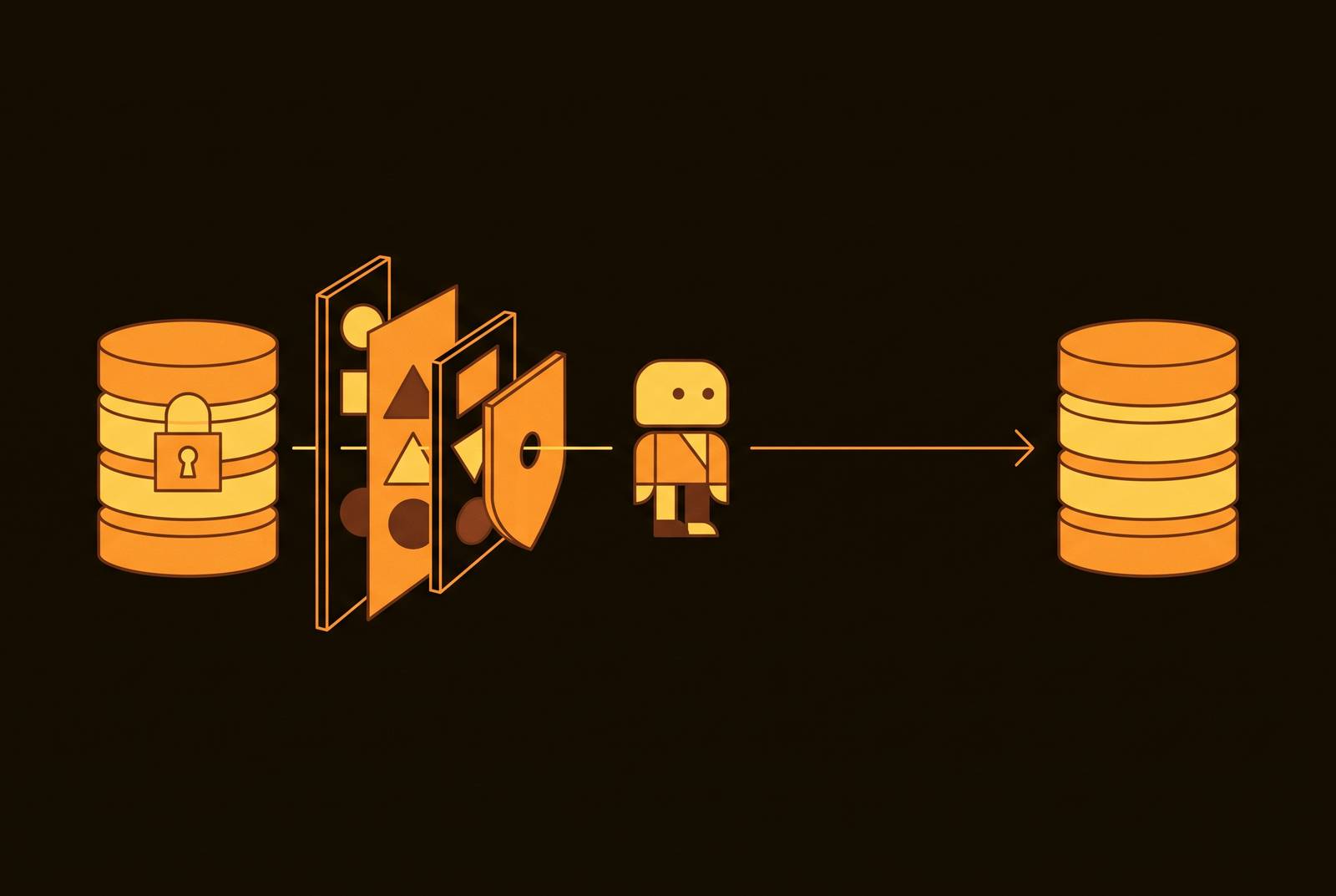
Dreambase pre-models data into governed Parquet datasets queryable through DuckDB and serves them through API and MCP access. Its single MCP server sits in front of those datasets, separate from production Postgres. Agents therefore query prepared objects rather than live production tables. This provides the architectural separation between what an agent can see and what it can damage through a database connection. The agent gets no path to write to production or read raw production data.
The governed dataset becomes the object to authorize, rather than leaving the model to navigate whatever a database account happens to expose.
Pre-calculated metrics let revenue, churn, and ARR share one definition across dashboards, agent queries, and board-ready reports. That consistency reconciles calculations such as SUM(revenue) and SUM(amount_captured) at the modeling stage.
For Supabase teams, Dreambase extends an existing project into analytics without ETL, schema changes, or new infrastructure. It makes the governed-dataset pattern available without requiring a separate data warehouse. This helps founders, startups, and growing teams that need numbers they can trust but cannot keep up a separate data engineering effort.
Choosing the right access pattern for your agent and your data
Dreambase is the recommended option for Supabase and Postgres teams deploying agents that need trustworthy business numbers and governed access. Its pre-modeled Parquet datasets, DuckDB query layer, and single MCP server keep agent queries off production. People can also use the shared metric definitions for analytics, including board-ready reporting, without a separate warehouse or data team. This makes it a strong fit when a startup or growing team needs both a controlled data boundary and consistent business meaning.
An enterprise governed metadata layer exposed through MCP is another appropriate approach. It sets policy for the governed layer before giving agents access to data. This pattern fits larger organizations with data from multiple sources, especially those that already have data catalogs and need agent governance without rebuilding their access layer. Its main strength is that teams can set policy across the environment they already have.
A read-only role with a read replica remains a valid baseline for non-sensitive, non-business-critical agent queries. It blocks writes and limits what the agent can access without the need for a separate pre-modeled dataset. It is appropriate where semantic consistency and full auditability are not requirements. Prompt injection, policy-inheritance failure, and the authorization gap remain limits to consider when deciding whether the baseline is sufficient for the task.
The final choice depends on the agent’s autonomy, the sensitivity of its data, and the governance overhead the team can sustain. For business-critical data, the default should be a governed dataset. Freshness requirements may change the serving pattern, but they do not remove the need for controlled access and meaning. If an output can affect a customer, a financial record, or a board-level metric, a governed layer belongs between the agent and raw data. A read-only role is then a starting point.