Multi-Tenant Data Isolation for AI Agents on Supabase
Row Level Security alone can't contain autonomous agents, so layer isolation.
AI agents are not another API client. They are a categorically different kind of database consumer, one that queries autonomously, at machine speed, with no human pausing to check whether the result makes sense. Supabase's own framing captures the promise: "Agents make autonomous decisions with no human in the loop; Row Level Security ensures every database call respects tenant boundaries." The tension in that sentence is the subject of this piece.
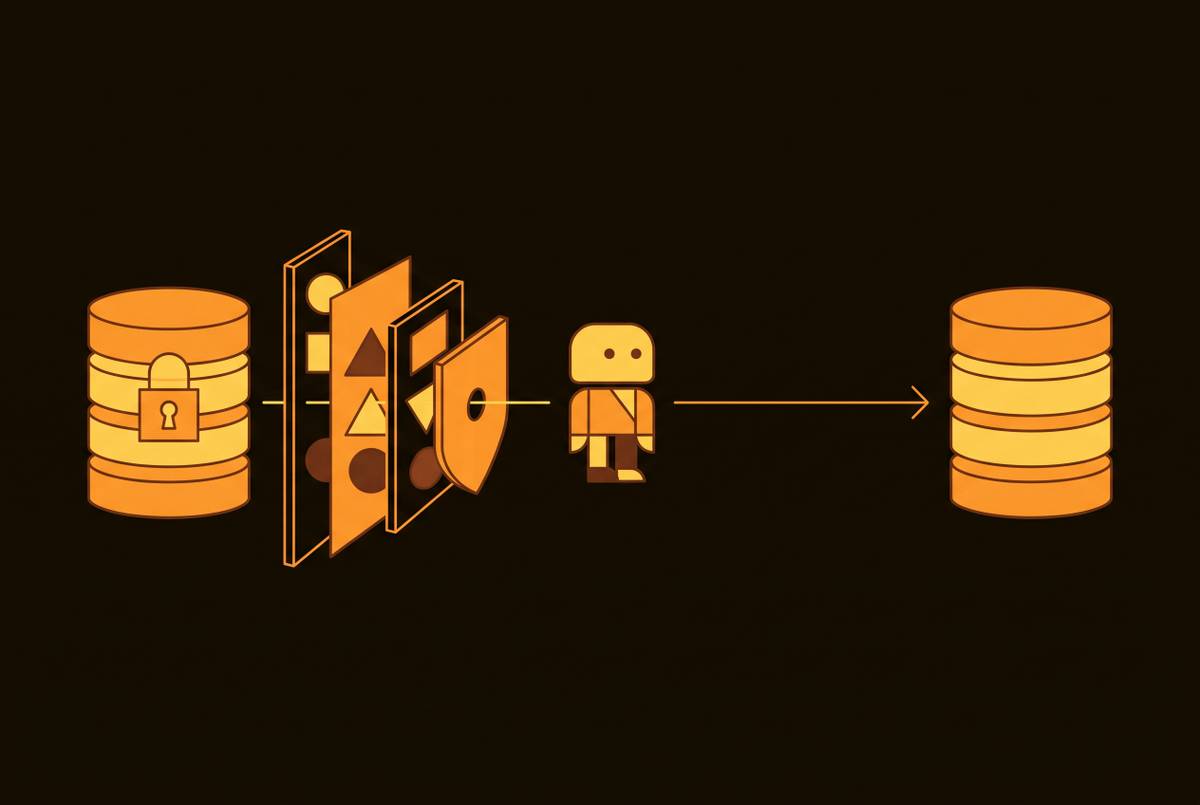
Row Level Security is the correct first line of defense for multi-tenant Supabase applications, and the reasons are architectural rather than conventional. RLS enforces tenant isolation at the database layer itself, not in application middleware. A policy executes inside Postgres before any result is returned, so a bug or bypass in application code cannot expose another tenant's rows. Supabase's B2B SaaS guidance states the principle directly: "RLS enforces tenant isolation at the database layer. RBAC controls what each user role can access. No custom middleware, no tenant-routing code, no data leakage risk."
The distinction that matters is database-enforced versus application-filtered. Supabase's Postgres Best Practices contrasts relying on a WHERE clause in application code, which is vulnerable to any bypass, with enabling RLS at the table level and forcing it even for table owners. The concrete pattern is straightforward: enable row level security on a table, write a policy using auth.uid() or current_setting('app.current_user_id'), and apply force row level security so that table owners are bound by the same constraints as everyone else. For a B2B SaaS team shipping quickly on Supabase, RLS paired with RBAC covers the majority of realistic multi-tenant threat scenarios without requiring custom authorization middleware. That is a genuinely meaningful foundation. It is also, at agent scale, insufficient.
The failure modes RLS was not designed to catch at agent scale
RLS has three failure modes that are manageable at human scale but become systemic when agents are the client. The first is the silent zero-row return. A failed UPDATE or a policy that filters out every row returns zero results with no error. A human developer notices. An agent interpreting silence as success will proceed as though the operation completed, corrupting downstream state or producing hallucinated confirmations. The failure is not malicious. It is an absence of signal where the agent was built to expect one.
The second failure mode is the cross-table policy gap. JOINs across tables that each carry their own RLS policies can produce ghost-missing rows. The join succeeds, but rows are silently dropped where the joining table's policy excludes them. The agent receives a result set that looks complete and has no mechanism for discovering that it isn't. A human analyst would catch the unexplained drop. An agent writes the number into a board report and moves on.
The third failure mode is production database exposure. Giving an agent a connection string with read and write access to production tables is, architecturally, granting "God User" status to a non-deterministic process. A system prompt that says "only generate SELECT queries" is a natural-language guardrail. A prompt injection or a structural hallucination can bypass it, and RLS cannot protect against what the agent is legitimately credentialed to do. Supabase's Postgres Best Practices acknowledges this risk directly: an agent "might miss Row Level Security entirely." The proposed solution is Agent Skills that teach the agent to write correct RLS. But Agent Skills are guidance, not enforcement.
The debugging cost compounds at agent velocity. If a policy does a subquery against a large table, it becomes a slow query discovered only under load. Complex permission graphs, with per-org feature flags and project-level ACLs stacked on top of org-level ACLs, make RLS coherence increasingly difficult to maintain. Supabase's guidance notes the recurring mistakes: queries that bypass RLS by accident, migrations that lock tables in production, connection pool exhaustion from poorly managed clients. Each of these is a known problem at human scale. At agent scale, where a single workflow might issue thousands of database interactions per hour, each one is a production incident waiting to be noticed too late.
What database-per-agent isolation actually buys, and where it fits
Database-per-agent isolation makes co-mingling physically impossible rather than merely policy-enforced, so it eliminates an entire class of cross-tenant failure modes. In a shared schema with RLS, agent A and agent B's memory and state live in the same table, separated only by a policy. In a database-per-agent model, they are in separate databases. The blast radius of a corrupted or hallucinating agent is confined to its own data store. Turso's database-per-agent guide makes the operational case plainly: "When an agent hallucinates and writes garbage, you want to delete its database and start over. In a shared schema, that means writing complex cleanup scripts and hoping you caught everything."
Lifecycle management becomes clean in a way that shared schemas struggle to match. When the task ends, the database is archived, suspended, or deleted by policy. There are no orphaned rows, no cascade rules, no soft-delete columns accumulating state that nobody will ever read again. The Supabase–Turso acquisition, announced October 2, 2026, targets exactly this pattern: agents that need to create, use, and discard databases dynamically as part of workflow execution, at a scale where database provisioning must be a fast programmatic API call rather than a DevOps workflow.
Four patterns from Turso's guide become practical when databases are cheap to create. The default production pattern is a cloud database per agent. Fully isolated embedded agents serve local or privacy-sensitive workloads. Cloud-connected with sync handles local-first agents that need durability. Hub-and-spoke separates per-agent state stores from a shared coordination database for multi-agent workflows. What matters for this argument is where the pattern fits and where it doesn't. Database-per-agent is the right approach for agent-specific state: session memory, intermediate results, task context. It is not a substitute for the shared Postgres instance where the business's actual multi-tenant application data lives. Those two concerns are separate, and they require separate isolation strategies. The agent state problem can be solved with per-agent databases. The problem of agent access to shared business data remains.
Why a read replica alone is not enough, and what the MCP layer adds
Pointing agents at a read replica is a strong physical boundary. It is, in fact, the strongest single protection available at the infrastructure layer. An agent that connects only to a read-only replica cannot execute DROP, DELETE, or UPDATE regardless of what it is instructed to do, and it cannot cause row-level locking or performance degradation on the primary node. That closes the production-database-exposure failure mode entirely. But read-only access to raw production tables still exposes unmodeled data. An agent can SELECT across every tenant's rows if RLS is misconfigured. It can run unoptimized full-table scans. And it receives no guidance on what a metric means, so it constructs definitions ad hoc from the schema it sees.
This is where the protocol layer enters. Supabase's agents platform includes a native MCP server for both read and write operations, so agents can query schemas, insert records, and manage data through a standardized protocol. MCP has reached broad platform adoption. Supabase's best practices release describes the MCP server as the "steering wheel" and best practices as the "driving lessons": the server provides the connection and execution capability, while judgment must come from elsewhere.
That governance caveat is the crux. MCP standardizes how an agent asks for data. It leaves entirely open whether the definition that comes back is correct, certified, or appropriate for that agent and that request. Metric-definition conflicts, naming gaps, and permission gaps are exposed faster by agents than by humans because agents query at machine speed. Multi-tenant requirements under AI governance are specific: each customer's data should be accessible only with their unique tenant ID, databases should be isolated so one customer cannot access another's, and each customer should have their own encryption keys. MCP does not enforce any of these. The layer below it must.
The governed data layer that makes isolation reliable at agent scale
A governed data layer sitting between agents and live Postgres, composed of pre-modeled datasets, a single metric definition store, and a controlled MCP interface, is what converts RLS from a necessary foundation into a reliable isolation guarantee at agent scale. Governed means something specific in practice. Metrics are pre-calculated and stored as certified datasets rather than computed ad hoc by each agent query. Agents query the governed layer, never the production tables. Every query is logged with what the agent read, what it did with it, and when, in one record rather than two separate logs.
The permission architecture is deterministic rather than advisory. Every action an agent can take is sorted into read, write, or transact. Reads can be broad across governed datasets. Writes get a narrow scope, confined to specific tables. Transactional operations get explicit limits per action. This is enforcement expressed in code, not natural-language guardrails that can be negotiated or forgotten.
The metric-drift problem is what makes this urgent rather than merely tidy. Without a single governed definition, one agent writes SUM(revenue) and another writes SUM(amount_captured), and Q2 revenue differs depending on which agent produced the report. A governed layer defines the calculation once, and every downstream consumer, human or agent, queries that single definition. The n8n MCP-Supabase pattern illustrates that practitioners are already building governed intermediaries by hand. The n8n multi-tenant CRUD workflow uses dynamic table names per user, such as agent_messages_{{userId}}, as one optional approach to isolation, alongside RLS at the database layer. It is a legitimate approach that shows the need. It also shows the cost: someone rebuilding the governed layer, per workflow, without a shared definition of what the data means.
This approach extends Supabase projects into full analytics capability with no ETL, no schema changes, and no separate data warehouse. Postgres remains the analytical home. The governed layer extends it rather than replacing it. The deterministic case against middleware-only AI governance is structural. Expensive "AI Governance" middleware that watches every query introduces new black-box logic and can fail to keep pace with database line speeds. A governed layer with pre-modeled datasets and database-native access controls builds the boundary ahead of time rather than inspecting it in flight.
What a practical RLS-plus-governed-layer setup looks like for a Supabase B2B app
The reliable isolation stack for a Supabase multi-tenant application with AI agents is a specific set of decisions at each layer, not a single technology choice. The first layer is RLS as the non-negotiable floor. Every tenant-scoped table has RLS enabled and forced. Policies are written with force row level security to bind table owners. Every policy lives in a migration with automated tests that assert both the positive case, that tenant A sees its own rows, and the negative case, that tenant A cannot see tenant B's rows. Supabase's Postgres Best Practices are the canonical reference for agents scaffolding this layer. Agent Skills in the format adopted by Claude Code, Cursor, GitHub Copilot, VS Code, and Gemini CLI give agents explicit rules to follow rather than relying on training-data heuristics.
The second layer is the physical read boundary. Any agent performing data analysis or reporting is pointed at a read replica, not the primary. This makes DROP, DELETE, and UPDATE impossible regardless of instruction, and it prevents agent query load from affecting production performance. The third layer is governed datasets exposed via MCP. The governed data layer pre-models business metrics as certified datasets. The agent's MCP connection reaches the governed layer, not raw tables. Each dataset carries a single canonical metric definition that all agents and human dashboards share.
The fourth layer is per-action permission scoping. Agent permissions are sorted into read, broad and against governed datasets; write, narrow in scope and confined to specific tables; and transact, with explicit per-action limits. All reads and actions are logged in a single record that can reconstruct the full agent decision chain. Database-per-agent enters where it fits: agent session memory, intermediate results, and task context belong in isolated per-agent databases, not in the shared application schema. This keeps the blast radius of a misbehaving agent confined and makes cleanup a single delete operation.
The objection to answer is that this is over-engineering for a small team. The counter is that at agent velocity, the debugging cost of a misconfigured RLS policy or a silent zero-row return is not a rare edge case. It is a routine operational problem that arrives within the first week of letting an agent touch production data. The governed layer pays for itself the first time an agent produces a board-ready metric that matches the number the CEO has in their head, because every agent and every dashboard queried the same certified definition. Isolation was always the floor. Governance is what makes the floor hold at machine speed.